
Research summary
Project overview
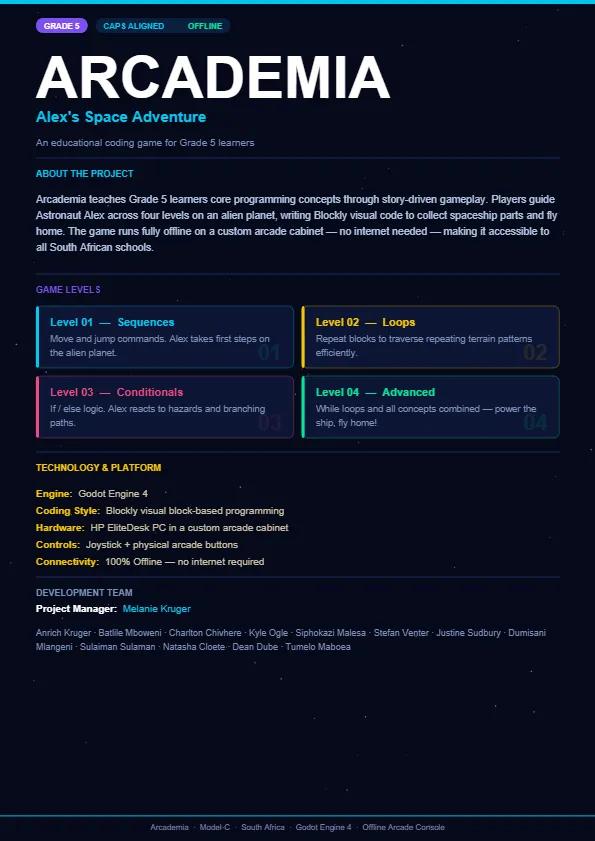
Arcademia is an educational coding game designed to introduce Grade 5 learners to programming concepts through interactive, story-driven gameplay. The system uses a visual block-based coding interface where students drag and arrange blocks to control a character, Astronaut Alex, through a series of platform-style game levels. The game teaches key programming concepts such as sequencing, loops, conditional logic, debugging, and computational thinking, while aligning with the South African CAPS curriculum for Mathematics and Life Skills. As players progress through four increasingly challenging levels, they help Alex collect spaceship parts to repair the ship and return home. Arcademia runs on a portable arcade console powered by a mini PC and developed using the Godot Engine, allowing it to operate entirely offline. Teachers can monitor student progress and manage learner accounts through a dashboard, while students can customize avatars, track scores, and complete coding challenges. By combining game-based learning, narrative engagement, and offline accessibility, Arcademia provides an inclusive tool for teaching programming in schools with limited internet access.